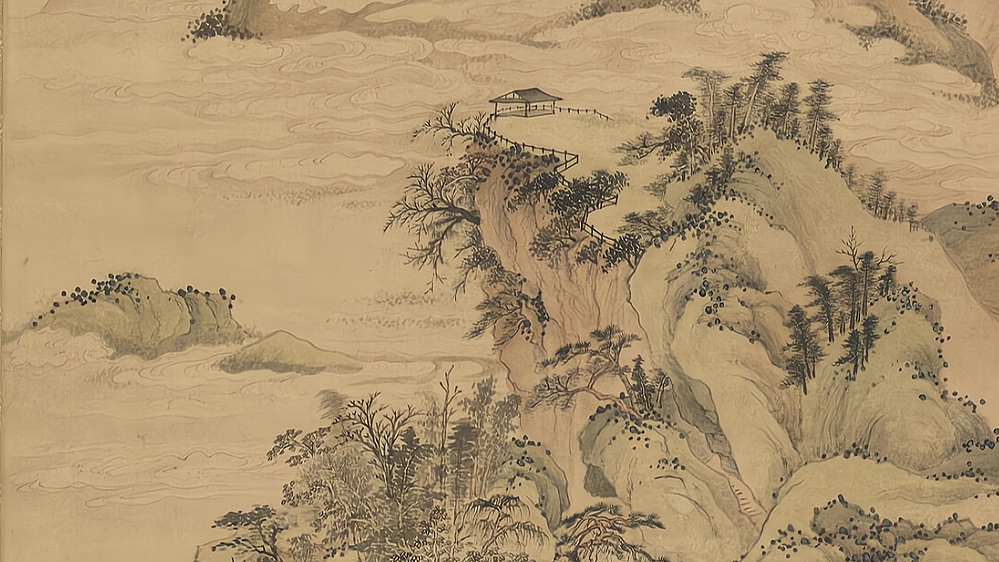
Wang Jian (painter)
Introduction
Wang Jian, a renowned Chinese painter, was a notable figure in the art circles of the early Qing Dynasty. He is recognized as one of the "Four Wangs," a group of influential landscape painters who played a pivotal role in shaping the artistic landscape of the period. Wang Jian's works are celebrated for their adherence to traditional Chinese painting techniques and styles. His artistic contributions, along with those of Wang Shimin, Wang Hui, and Wang Yuanqi, are deeply rooted in the literati styles of southern China, emphasizing the imitation of ancient and classical painting styles. Wang Jian excelled in both monochrome and polychrome ink works, as well as color paintings, and his art remains a significant part of Chinese cultural heritage.
Biography
Wang Jian was born in 1609 during the late Ming Dynasty (1368-1644), a period marked by political and social upheaval in China. He hailed from a family with a rich artistic tradition, which significantly influenced his early exposure to art. Growing up in an environment that valued cultural pursuits, Wang Jian developed an early interest in painting and calligraphy, disciplines that were highly esteemed among the literati of the time. His upbringing in a culturally enriched environment provided him with the foundational skills and appreciation for the arts that would later define his career as a painter.
Artistic Style
Influences
Wang Jian's artistic style was heavily influenced by the literati tradition of southern China, which prioritized the emulation of classical styles and the integration of personal expression. He drew inspiration from earlier artistic icons such as Huang Gongwang and Ni Zan from the Yuan Dynasty (1271-1368), as well as Dong Qichang from the Ming Dynasty. These influences are evident in Wang Jian's works, which often feature elements of traditional Chinese landscapes and reflect a deep appreciation for the natural world. His paintings harmonize the elegance and simplicity favored by the literati with the technical precision inherited from his predecessors.
Techniques
Wang Jian is renowned for his mastery of both monochrome and polychrome ink works, along with color paintings. His technique involved the use of delicate brushstrokes and subtle shading to create depth and texture, capturing the essence of Chinese landscapes in a way that was both realistic and expressive. Wang Jian's works often exhibit a balance between traditional landscape motifs and innovative compositions, demonstrating his ability to honor past traditions while contributing his unique perspective. His art reflects a meticulous attention to detail and a profound understanding of the interplay between form and space, hallmarks of his enduring legacy in Chinese painting.
Notable Works
Wang Jian's body of work includes several masterpieces that exemplify his artistic vision and technical prowess. Among his most celebrated works are his landscape paintings, which capture the serene beauty of the Chinese countryside. His ability to convey the subtle nuances of nature through ink and color has made his paintings timeless examples of traditional Chinese art. These works not only reflect the aesthetic values of the Qing Dynasty but also embody Wang Jian's personal interpretation of the world around him, offering viewers a glimpse into his artistic soul.
Legacy
Wang Jian's influence on Chinese art extends far beyond his lifetime. As a member of the esteemed "Four Wangs," he played a crucial role in shaping the artistic landscape of the Qing Dynasty and establishing the orthodox school of Chinese landscape painting. His works continue to be celebrated for their technical excellence and adherence to classical traditions, serving as a source of inspiration for subsequent generations of artists. The legacy of Wang Jian is preserved in numerous collections, including those of the Palace Museum, which houses an extensive array of his paintings. His contributions to Chinese art remain a testament to his enduring impact on the cultural heritage of the nation.








